Let’s Replace Trump with a Cherry Tree
The perfect metaphor

Let’s Replace Trump with a Cherry Tree
If someone wanted to write a metaphor for the Trump presidency, they couldn’t invent a better one than this: cut down century-old cherry trees, gifts of international friendship, symbols of beauty, humility, and the fleeting nature of life, to build another golf course. There, in a single sentence, is the entire philosophy of Donald Trump. If it doesn’t serve his ego, it is expendable. If it cannot be branded, monetized, or turned into another monument to himself, it becomes an obstacle to be removed. The symbolism isn’t subtle. It’s almost too perfect.
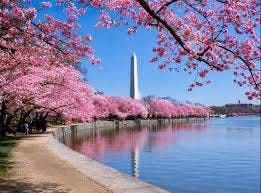
The irony is uniquely toxic. Here is a man who has spent his entire adult life demonstrating that he knows next to nothing about genuine art, history, diplomacy, or even the natural world, deciding that one of America’s most treasured living landmarks should make way for another vanity project. These are not simply ornamental trees standing in the wrong place. They are among the oldest surviving descendants of the original Japanese cherry trees gifted to the United States more than a century ago as an extraordinary act of friendship between two nations. They have stood through world wars, economic collapse, assassinations, civil rights struggles, and every president since William Howard Taft. Now they find themselves threatened not by nature, disease, or time, but by the vanity of one man who cannot distinguish between stewardship and ownership.
For more than a thousand years, the Japanese have celebrated hanami, the annual viewing of cherry blossoms, recognizing in those delicate flowers something profoundly human. The blossoms arrive with breathtaking beauty, linger only briefly, then quietly fall away, reminding us that life itself is temporary and that beauty requires neither conquest nor ownership. Entire generations have written poetry beneath those branches, painted them, photographed them, and gathered families together simply to appreciate something larger than themselves. They ask nothing of us except our respect. Donald Trump, on the other hand, apparently looks at those same trees and sees little more than an inconvenience standing in the way of the ninth hole. That contrast tells you everything you need to know.
It also tells you something about the disease that has infected our politics. A man incapable of appreciating symbolism beyond his own branding somehow believes he is qualified to redesign the nation’s capital according to his personal tastes. First came the bastardization of the White House grounds, transformed into something resembling the entrance to a luxury resort rather than the home of a constitutional republic. Then came the expensive reconstruction of the Deflection Pool, now remembered less for reflection than for algae and embarrassment. Now come oversized arches and monuments that look less like timeless American architecture and more like something Nigel Tufnel from This Is Spinal Tap might proudly unveil after announcing he’d accidentally shrunk Stonehenge. Every historic space becomes another opportunity for Donald Trump to scratch his name into America’s furniture. He doesn’t preserve history. He autographs it.
Authoritarians have always confused stewardship with ownership. They convince themselves that national treasures belong to them simply because they temporarily occupy positions of power. Museums become propaganda halls. Parks become parade grounds. Public institutions become branding exercises. Sacred spaces become stages upon which the leader can perform his greatness. The scenery changes from country to country, but the psychology never does. Donald Trump seems incapable of looking at a historic landscape without wondering how it might better advertise Donald Trump.
What makes this proposal even more grotesque is its complete disregard for what those trees actually represent. They are not simply Japanese gifts to America. They are living expressions of diplomacy, something Trump knows nothing about, reminders that nations can build relationships through generosity instead of domination and beauty instead of conquest. At the very moment Japan is preparing to send another 250 cherry trees to help commemorate America’s 250th anniversary, a renewed gesture of friendship, we are seriously discussing whether the oldest surviving grove should be sacrificed so a billionaire president can improve his golf course on public land. If a novelist submitted that plot, an editor would reject it as implausible satire. Yet somehow, it has become another day in modern America.
Predictably, the defenders will insist this is simply progress, economic development, or beautification. They already have. Those words have always been the preferred vocabulary of people preparing to destroy something irreplaceable. Every unnecessary demolition is marketed as progress. Every assault on public spaces is wrapped in patriotic language. Every act of cultural vandalism is rebranded as improvement. Somewhere along the way, however, we stopped asking the obvious question: improvement for whom? Certainly not for the families who picnic beneath those blossoms every spring. Not for the cyclists who use the riverside trails. Not for historians, conservationists, or Americans who understand that some things possess value precisely because they cannot be measured on a balance sheet. This project serves only one constituency, the insatiable ego of Donald Trump.
Perhaps the one of the most exhausting part of this presidency is that everything eventually bends toward him. Every institution. Every public square. Every military parade. Every government building. Every national celebration. Every patch of public land. Nothing is allowed to exist simply for its own sake. Everything must become another backdrop for self-glorification, another branding opportunity, another monument to a man whose appetite for attention seems incapable of being satisfied. The presidency ceases to be public service and instead becomes interior decorating on a national scale.
What continues to astonish me isn’t simply Trump’s predictably shallow worldview. It’s the astonishing number of enablers who continue to facilitate it. Lawyers, architects, consultants, cabinet members, bureaucrats, political allies, and anyone else willing to trade principle for proximity to power all become accomplices. None of this happens because one man wills it into existence. It happens because countless others decide that protecting their careers is more important than protecting their country’s history. Cowardice, more often than malice, is what clears the ground for the bulldozers.
I came across a comment that made me laugh despite everything: “I say we replace the president with a cherry tree.” The more I thought about it, the less it sounded like satire and the more it sounded like an upgrade. A cherry tree doesn’t demand applause. It doesn’t require loyalty oaths. It doesn’t insist that every camera be pointed in its direction. It doesn’t need its name engraved on buildings or golf courses. It simply stands where it is planted, offering beauty without demanding credit, shade without demanding obedience, and every spring quietly reminding us that renewal is possible if we possess the wisdom not to destroy what previous generations entrusted to our care.
The real measure of any civilization isn’t how many monuments it builds to itself. It is whether it has the humility to preserve the ones it inherited. Donald Trump and his craven administration has failed that test over and over again, and the cherry trees have become the latest victims of a worldview that cannot recognize value unless it carries his signature. The only question that remains is how much more of our shared inheritance his enablers will allow him to bulldoze before someone finally has the courage to tell him that not everything in America exists for the pleasure of one profoundly incurious man.
Michael Jochum
Not Just a Drummer: Reflections on Art, Music, Politics, Dogs, and the Human Condition
I had not heard this. I had no idea that he intends to remove the cherry trees. If we replace him with a cherry tree, can we then chop it down?
Truly, this makes me want to vomit.