Democratic Erosion
Weaponized Grievance

Let’s stop pretending this is complicated. What we are living through in this country feels less like conventional politics and more like a sustained struggle over the meaning and survival of democratic institutions themselves. For those of us watching the steady expansion of executive power, the erosion of institutional norms, the increasingly open contempt for due process, the normalization of dehumanizing political rhetoric, and the weaponization of grievance as governance, it becomes harder by the day to dismiss this as mere partisan dysfunction. This is not politics as usual. It is something darker, more deliberate, and far more structurally corrosive.
If you believe American democracy is healthy and functioning as intended, I honestly don’t know what evidence you’re looking at. We are living through a period where institutional guardrails have been repeatedly stress-tested, where loyalty to a political figure often appears to supersede loyalty to constitutional principle, and where entire segments of public discourse have become conditioned to accept behavior that, in another era, would have been politically disqualifying. Neutrality at a moment like this is often framed as sophistication, but sometimes neutrality is simply avoidance, an unwillingness to confront what is plainly in front of us.
Every expansion of executive immunity, every assault on civil liberties, every attempt to redefine dissent as disloyalty, every effort to weaken oversight, every cynical propaganda narrative, every act of performative cruelty dressed up as strength, none of this exists in a vacuum. These are not isolated episodes. They form a pattern. Whether one chooses to call that pattern authoritarianism, democratic backsliding, or constitutional erosion, the effect is the same: public trust collapses while centralized power expands.
What’s especially disturbing is how familiar the architecture looks to anyone who has studied history. Authoritarian systems rarely arrive announcing themselves as tyranny. They present themselves as restoration. They promise order. They identify enemies. They insist only one leader can solve the crisis. They cultivate grievance, reward loyalty, punish dissent, and gradually transform institutions into instruments of personal or ideological power. History doesn’t repeat in exact costume, but the structural echoes are difficult to ignore.
This is not how democratic collapse traditionally looks in movies, where tanks roll dramatically through capitals and constitutions are torn up in public squares. Modern democratic erosion is often bureaucratic. Procedural. Legalistic. It happens through appointments, court decisions, executive actions, administrative capture, and the normalization of exceptional behavior until the exceptional becomes routine. Democracies are not always overthrown; sometimes they are hollowed out from within, one precedent at a time.
And that is what feels so dangerous about this moment. Not simply the rhetoric, but the conditioning. The repeated insistence that cruelty is strength. That accountability is persecution. That dissent is treason. That truth is negotiable. That political violence is understandable. That institutional independence is somehow the enemy. These are not merely campaign messages. They are cultural rewiring mechanisms.
The most unsettling reality may be how many Americans have simply adapted to the noise. Outrage exhaustion becomes its own anesthetic. Scandal fatigue becomes surrender. The constant barrage of spectacle numbs the public into accepting what would once have triggered universal alarm. That may be the most effective authoritarian tool of all, not overt repression, but normalization.
History is unsparing about moments like this. It remembers not only the architects of institutional decay, but also the bystanders who convinced themselves the danger was exaggerated, the collaborators who rationalized it, and the citizens who assumed someone else would stop it. Whatever history ultimately calls this chapter, it will not judge indifference kindly.
Michael Jochum
Author of Not Just a Drummer: Reflections on Art, Politics, Dogs, and the Human Condition
Veteran drummer, writer, observer of the absurd, and still foolish enough to believe truth matters.
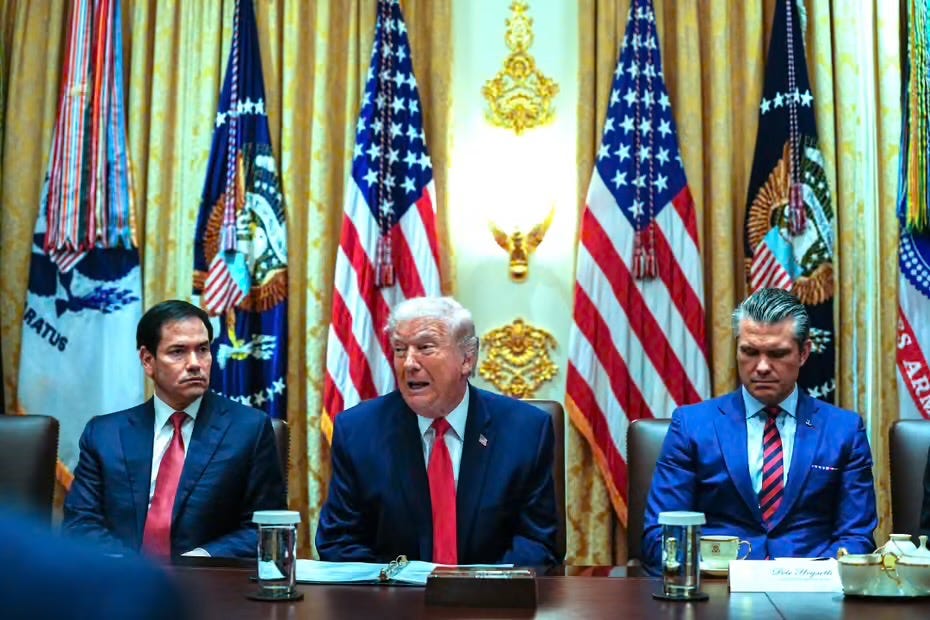
Thank you, Michael, for clarifying how the Trump presidency has evolved. I kept wondering how on earth the USA could have voted for such a monstrosity of a man to be your president. I am sure there is a lesson in this for all of us, wherever we live in the world.
You’re a very good writer, you think clearly and have the art of precise expression. As to how to proceed, let’s all - all people of good will for the future - put our minds together and join our voices with others for strength and success. At present, I see the nations, cities, companies, and indigenous people that have agreed to ending fossil fuels as my team. I call them Team Off Fossil Fuels. OFF. https://www.fossilfueltreaty.org/ I am also on Team Leo XIV. And he is probably on Team OFF.